
☀️ Daytime — but ISS passes tonight
Set a reminder for the ISS pass. 🌇 Sunset later today — check back this evening.
Wait for sunset — nothing visible in daylight.
Clear sky · Thin moon · City sky
- Next ISS pass✓ Visible
- 5:24 PM
- Visible 6 min · peaks at 32°
- Meteor shower
- No major events
- Quiet sky tonight
- Moon
- Waxing Crescent · 22%
- Above horizon
- Sunset
- 7:04 PM
- Daytime now
Tonight's highlights
Live · updated every 15 minutesSee your city's sky tonight
Pick any city to view its planets, moon, weather, and ISS passes.
Explore the sky from any city
See what's visible tonight — planets, the Moon, ISS passes, and meteor showers, all adjusted for local weather.
Know what the sun is doing — right now
Track geomagnetic storms, solar flares, and the solar wind in real time. Plain-language impact for aurora chasers, ham radio operators, pilots, and satellite watchers — no jargon required.
- Live Kp index + 3-day storm forecast
- Solar flare classification (A → X) with 6-hour timeline
- Radio blackout alerts on the R-scale
- What each event means for your activities
B3.1
Active
km/s
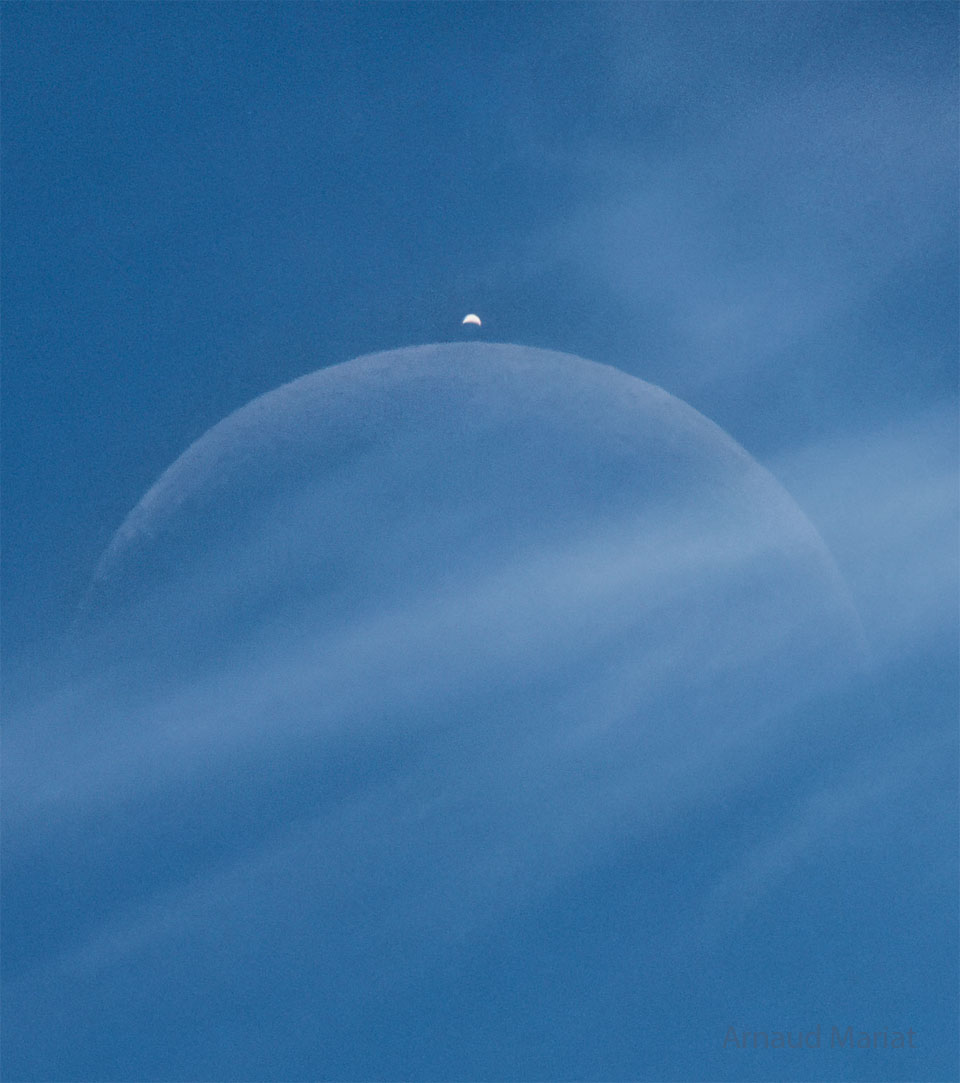
A Daytime Eclipse: Moon Occults Venus
There was something behind the clouds. Upon close inspection, it was the Moon, which was hard to see yesterday around noon above the small village of Cessy, France. But soon, it was not only the Moon. As expected, a bright dot suddenly appeared from behind the Moon -- the planet Venus far in the distance. Captured in the single featured exposure, both appeared to show a crescent phase. The Moon's crescent was quite slight -- with only about 10 percent of its face illuminated by the Sun. In contrast, Venus's crescent was more full -- showing about 25 percent illumination. Venus appeared brighter because it is nearer the Sun and because its clouds are more reflective than the dark lunar surface. An occultation of Venus by the Moon is visible to only about 10 percent of the Earth, but in yesterday's event even most of that was experiencing daytime. APOD's main NASA site is moving: From apod.nasa.gov to science.nasa.gov/apod
Read the full explanation(2026 HJ)
Six ways to explore space
Every feature is live, free, and requires no account.
Tonight's Sky
Interactive panoramic sky view — search any city to see planets, the Moon, ISS passes, and meteor showers at their real positions.
Asteroid Tracker
Every near-Earth object approaching in the next 60 days — sorted, filtered, with distance meaning and risk classification.
Aurora Forecast
Cloud-adjusted Kp visibility for the world's best high-latitude cities — per-hour probability for the next 72 hours.
Space Weather
Live geomagnetic storms, solar flare class, radio blackout risk, and solar wind conditions — with plain-language impact.
Meteor Showers
Full annual calendar of major meteor showers — peak dates, expected hourly rates, and viewing tips for each event.
Picture of the Day
NASA's Astronomy Picture of the Day — a new image of the cosmos every 24 hours with expert explanation.
How it works
From picking a city to tracking asteroids — three steps, zero sign-up.
Pick a city
Search any of 33,000 cities worldwide or use your current location. Each city gets a personalised sky report.
See the live sky
Explore an interactive panoramic view with real-time planet positions, the Moon, ISS passes, and meteor showers — adjusted for local weather.
Track asteroids & aurora
Monitor near-Earth objects with risk classification, and check cloud-adjusted aurora forecasts for the world's best viewing cities.
From the blog
Stargazing guides, space news, and how-tos for upcoming events.

On This Day in Space: Historical Milestones and Discoveries
Every day has astronomy history. Moon landings. Discoveries. Launches. See what happened on this day in space exploration.

Near-Earth Asteroids: Why We Track Them and How to Spot One
Thousands of asteroids orbit near Earth. Learn why scientists monitor them, how close they actually come, and what happens if one is headed our way.

Stars Explained: Types, Colors, Distances, and Death
From red dwarfs to blue supergiants, stars come in wild varieties. Learn their types, how we classify them, and what their colors reveal.
Answers to common questions
Everything you need to know about the data, the forecasts, and what SkyTracko tracks for you every night.
SkyTracko shows you which planets, the Moon, the ISS, and meteor showers are visible from your city right now — cloud cover and moon phase included. Pick a city from the hero above or open the sky map to see a per-city report.
We combine NOAA's Kp index forecast with real-time cloud cover from Open-Meteo to produce a per-hour, cloud-adjusted visibility probability for each city. The forecast refreshes every 15 minutes and covers the next 72 hours.
The asteroid tracker lists every near-Earth object approaching in the next 60 days, sourced from NASA NeoWs. You can sort by closest, soonest, largest, or highest risk — and see the distance in lunar distances plus plain-language meaning ("Inside lunar orbit", "Well beyond lunar distance", etc.).
Asteroid data refreshes every minute in the browser and is synced from NASA NeoWs every six hours. Aurora and sky conditions refresh every 15 minutes. Each page shows the most recent sync time so you always know how fresh the reading is.
Yes — every feature on SkyTracko is free and requires no account. Optional sign-in is planned to let you save your favourite city and get notified about notable asteroid approaches and aurora events.
Can't find what you're looking for? Every feature page has its own detailed explainer and methodology notes.